






Domain authority has become a key indicator of how well your WordPress website will rank on SERP. A higher DA means better visibility, stronger credibility, and more opportunities to rank on search results.
However, improving this metric doesn’t only include publishing quality content. You have to follow and adopt practical steps to increase domain authority, such as broken link detection, quality backlinks, internal linking, etc., for good results.
In this guide, we’ll talk in detail about those tips and tricks to improve domain authority. Moreover, this blog will reveal key influencing factors and answer some of your essential queries.
Quick Overview
Improving domain authority (DA) for a WordPress site involves strengthening its overall SEO health, backlink profile, and user experience.
To increase domain authority, WordPress site owners should adopt or consider the following strategies:
- Earn high-quality backlinks from authoritative and relevant websites, as strong referring domains have the biggest impact on Moz Domain Authority.
- Publish valuable, link-worthy content that satisfies search intent and naturally attracts backlinks over time.
- Fix broken links regularly to maintain site credibility and improve both user experience and crawl efficiency.
- Strengthen internal linking by connecting related content to distribute link equity and improve site structure.
- Optimize on-page SEO elements, including titles, headings, meta descriptions, URLs, and image alt text, to improve visibility and relevance.
- Improve user experience (UX) by ensuring fast load times, mobile responsiveness, clean layouts, and readable content.
- Set up and maintain an XML sitemap so search engines can easily discover and index important WordPress pages.
- Reduce bounce rate and increase engagement through clear navigation, compelling CTAs, and scannable formatting.
- Avoid spammy or low-quality backlinks, as they can negatively affect domain authority and trust signals.
- Monitor domain authority regularly using a reliable domain authority checker to track progress and identify issues.
Be consistent and patient, as domain authority typically improves over several months, not instantly.
What is Domain Authority?
Domain authority is a Moz ranking metric that scores a site from 1 to 100 to indicate how likely a website is to rank on search engines. The higher score indicates a greater possibility of ranking on SERP.
Factors that influence domain authority
There are some key factors that greatly influence the domain authority of your site. Depending on these factors, Moz determines your site authority.
So, here are the key factors that leave an impact on the site’s domain authority:
- Quality links from high authority sites.
- Increased number of backlinks.
- Valuable content linking with credible sites.
- Domain age and brand authority.
- Relevance in internal linking.
- Free from broken links.
- Proper on-page SEO.
- Low bounce rate.
- Better user experience.
Tips to improve the domain authority of WordPress site
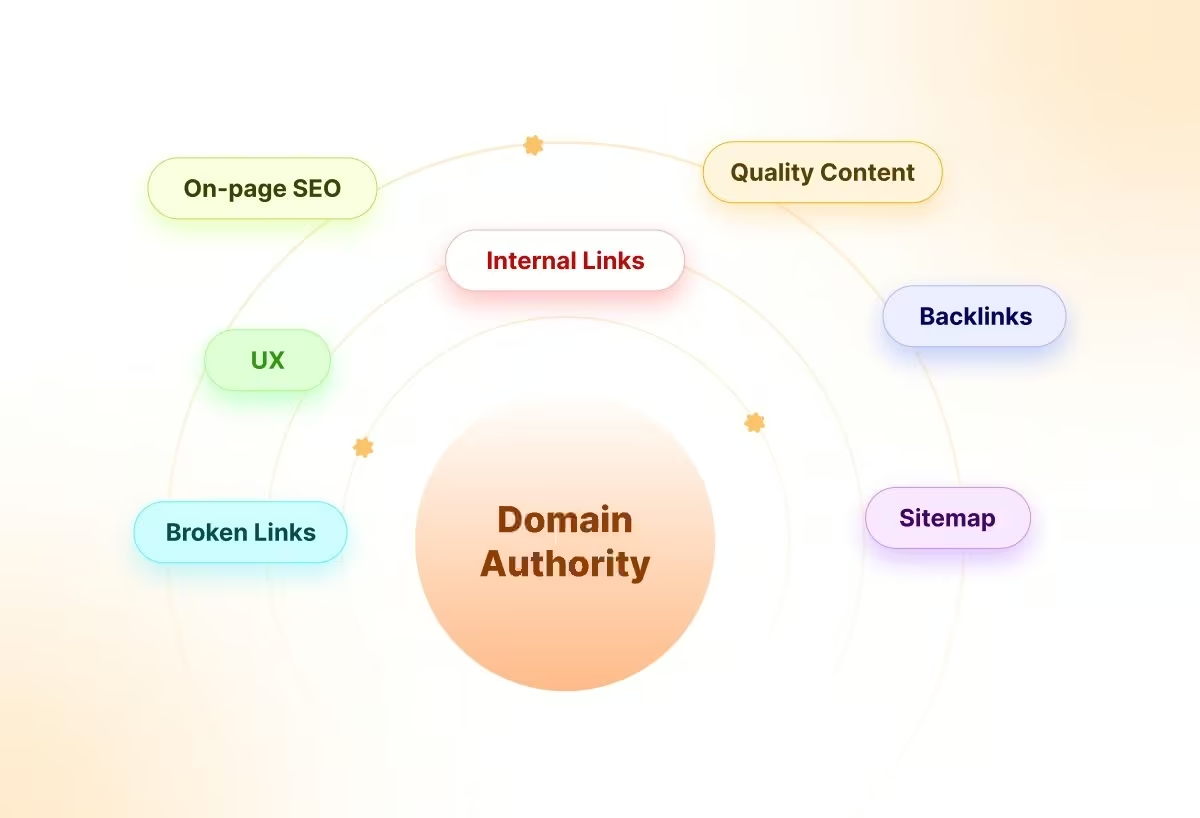
Increasing domain authority is a continuous process where you can’t expect an overnight result. You have to regularly work on it. The time of getting results varies from site to site, depending on the site’s current state. Hence, you should have patience while improving domain authority with result-driven tips and tricks.
Here are the strategies that will guide you how to improve the domain authority of WordPress site:
Get High-quality backlinks
Quality backlinks play a crucial role in increasing domain authority. Google gives priority to sites that have backlinks from authoritative sites. However, you have to be careful during getting backlinks. Randomly getting backlinks can deteriorate your site. So, receive backlinks only from the relevant and credible sites.
Backlinks can be gained by:
- Posting a guest post.
- Outreaching to link to relevant resources.
- Writing link-worthy content.
- Featuring on industrial blogs.
- Link exchange on expert roundups.
- Submitting to directory sites.
- and so on.
Apart from these, you will find many more tactics to get high-value backlinks. These are the most common ones. Follow these for ongoing backlink collections.
Fix or remove broken links
A site with broken links will negatively impact user experience as well as domain authority. If a search engine detects noticeable dead links, it will detect your site as a non-maintained site that lowers your credibility. So, you have to regularly audit your site and identify broken links. Once found out, update with correct links or entirely remove them.
This will reduce audience frustration by letting them land on the right link. Also, you can maintain proper internal links by periodically detecting and replacing broken links.
Improve internal linking
Internal linking is another effective way to boost domain authority. It allows you to drive audiences to other relevant pages of your site. Appropriate internal linking will increase crawlability and help search engines understand your website structure. Not only crawlability, but also your audience will keep engaged on your site.
So, make sure to link relevant posts or topics during writing or updating your content. You can use internal link optimizer tools for that. It will suggest relevant links that will let you transfer link juice to other pages of your site. Internal link is one of the most important ranking factors that has a high impact on domain authority as well.
Generate quality content
Publishing helpful resources will increase the visibility and engagement of your site. Through quality content, you can reach more people, which provides a green signal to Google ranking. With the ongoing demand, search engines will give priority to rank your content on SERP. Along with visibility, DA will be positively impacted.
Hence, write and publish problem-solving content that fulfills user intent. Besides publishing, optimize and update that content regularly to provide up-to-date information. Also, focus on better readability while crafting helpful content by
- Adding images, infographics, and videos.
- Using short sentences and paragraphs.
- Linking suitable resources.
- Adding proven statistics.
- Using proper headings and subheadings.
- etc.
These will let you generate valuable content for your site.
Set sitemap
Apart from quality content, you need to set and maintain a sitemap for your WordPress site. This helps search engines to recognize your web pages and give them ranking benefits if they stand on helpful content guidelines.
Basically, a sitemap is a roadmap, linking all important pages of your site so that search engines can easily discover and index without missing anything. You can use WordPress tools such as Yoast SEO, XML Sitemap Generator, etc., to integrate a sitemap with a few clicks. This makes a search-engine-friendly site, which positively contributes to domain authority.
Boost user experience
UX is another significant role in improving domain authority. To smoothen UX, you have to maintain a clean layout, ensure mobile-responsiveness, use scannable paragraphs and structured headings, optimize page speed, use call-to-action buttons, etc. All these will boost engagement by increasing readability.
An enhanced engagement sends a positive signal to search engines that indicates the credibility of your site. After getting this signal, search engines give priority to rank your site on search results. This results in an increase in the domain authority of your site.
Optimize on-page SEO
On-page SEO optimization boosts visibility by helping search engines understand and rank your pages accurately. When your content is properly optimized, search engines are more likely to position your content on the SERP. This allows you to draw more traffic, visibility, and engagement, which further boosts overall domain authority.
Therefore, start optimizing content with relevant keywords in the title, heading, alt text, meta description, seo title, and body. Also, ensure the URL is short and clear, avoid keyword stuffing, compress files, add internal links, maintain heading hierarchy, etc., for on-page SEO optimization. With consistent optimization, your site’s authority will gradually rise and provide long-term results.
Reliability of domain authority score from Moz, Ahrefs, and SEMrush
While Moz Domain Authority (DA), Ahrefs Domain Rating (DR), and Semrush Authority Score (AS) are widely used to estimate a site’s SEO strength, it’s important to recognize that none of these are official Google ranking signals. They are third-party metrics created by SEO platforms to help professionals gauge backlink profile strength and overall site health.
Here is how these tools score your site:
Moz Domain Authority (DA)
Focus:
Predicts a website’s overall ranking potential using a machine-learning model.
Key Signals Used:
- Quality and quantity of backlinks
- Linking root domains
- Spam score
- Domain age and historical link patterns
Score Range: 1 to 100
Ahrefs Domain Rating (DR)
Focus:
Measures the strength of a website’s backlink profile only (link equity).
Key Signals Used:
- Number of referring domains
- Authority of linking domains
- Distribution of link equity
Score Range: 0 to 100
Semrush Authority Score (AS)
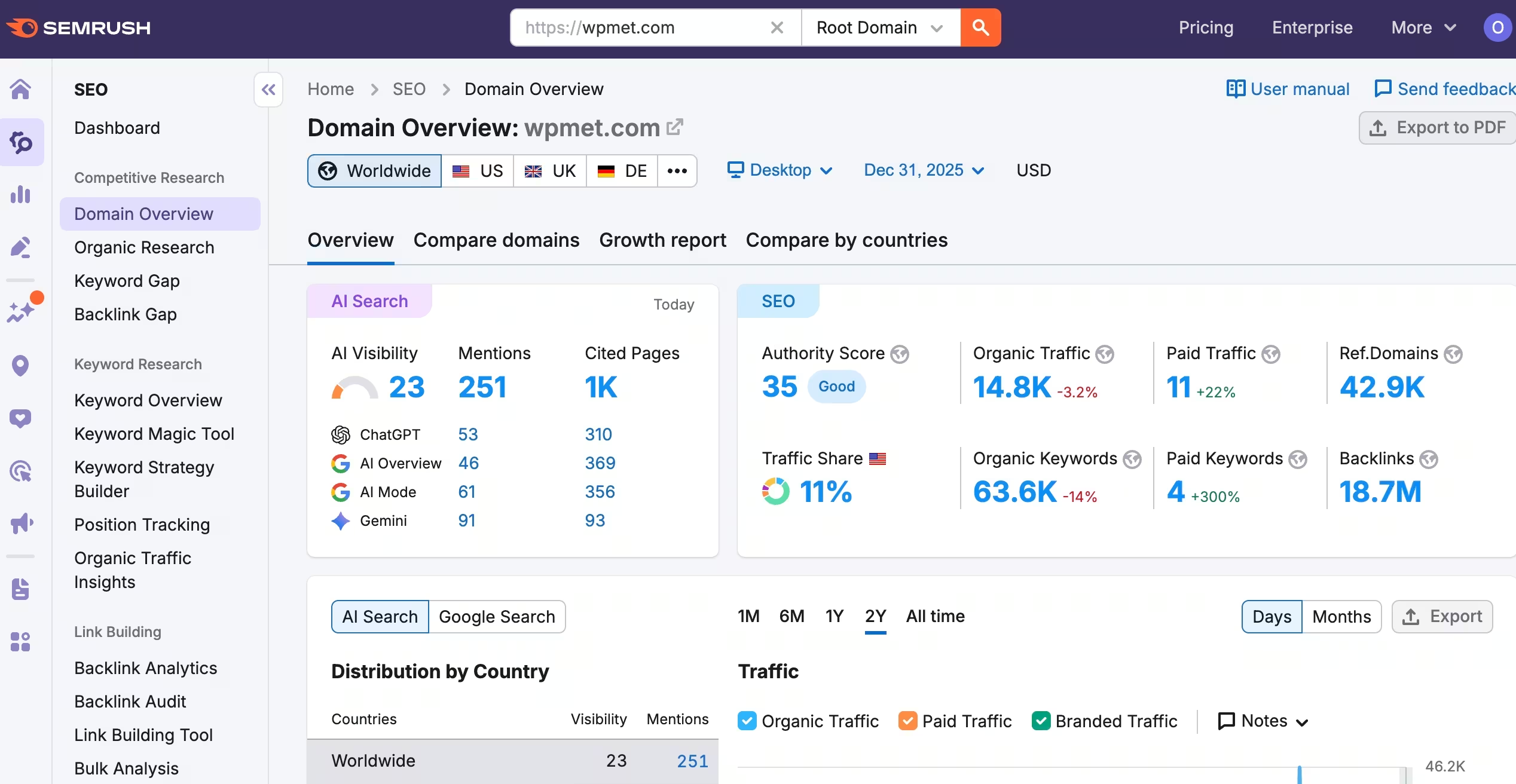
Focus:
Provides a holistic authority score by combining multiple SEO signals.
Key Signals Used:
- Backlink profile strength
- Organic search traffic
- Spam and link toxicity indicators
Score Range: 0 to 100
Which authority metrics you should use?
There is no single best authority metrics. The right metrics will depend on your goal. Here is which one you should consider when:
- Semrush Authority Score: For a complete SEO health overview.
- Ahrefs Domain Rating: Backlink analysis and link building opportunities.
- Moz Domain Authority: Basic tracking and reporting.
FAQ
What’s a good score for your Domain Authority?
A score from 40 to 50 is considered average, and from 50 to 60 indicates a good score. Besides, sites with a score of above 60 are marked as excellent.
Do spammy backlinks affect DA?
Yes, spammy backlinks can affect domain authority and ranking opportunities. So, keep an eye on spammy scores while collecting backlinks.
How often does Moz update domain authority?
Domain roughly updates every 3 to 4 weeks. The period of updating the domain authority may vary upon new backlink discovery.
How long does it take to improve domain authority?
The time varies from site to site. It is usually between 2 to 6 months, depending on your content quality, backlinks, and SEO efforts.
Wrapping up
Increasing domain authority is a long-term process where you can’t expect instant results after adopting strategic approaches. These tips will steadily grow your site authority and ranking possibilities. So, patiently follow these tips and slowly move forward to your goal.
With an ongoing backlink collection, broken link fixing, valuable content generation, sitemap setting, proper internal linking, etc., you will get proven results over time. So, take attempts and start optimizing your site for a higher DA.


Leave a Reply