



When Google introduced AI Overview in May 2024 to make information easier to access, we quickly noticed that many of our long-published WordPress and web design articles in Wpmet were already appearing in these summarized results.
We see this change as a great opportunity to get closer to our ideal readers. Through the Google AI Overview, our target readers are asking natural, conversational questions and looking for simple explanations of complex topics.
AI Overview gives users an instant understanding while encouraging them to explore deeper. Seeing our content surface in this space motivated us to study what worked and refine our approach.
And, in this detailed write-up, you’ll be going to learn how we got Wpmet blog featured in Google’s AI overview and how you can too. Let’s start with the basics:
Short Overview
Wpmet is an authority blog site in the WordPress web design niche, publishing high-quality tutorials, guides, documentation, blogs, and other authentic types of content for years.
This site has been featured in Google AI Overview for various keywords. Here’s what they’ve done so far:This tutorial includes lorem ipsum dolor sit amet.
✅ Comprehensive how-to guides are prompt-friendly and relevant to search queries.
✅ Published content is reader-friendly and easy to understand.
✅ Most of the blog content outline has covered all the relevant questions in a specific topic.
✅ Wpmet is also popular on YouTube and social platforms like Facebook, Instagram, TikTok, Twitter, and LinkedIn for web design learning.
What Are Google AI Overviews?
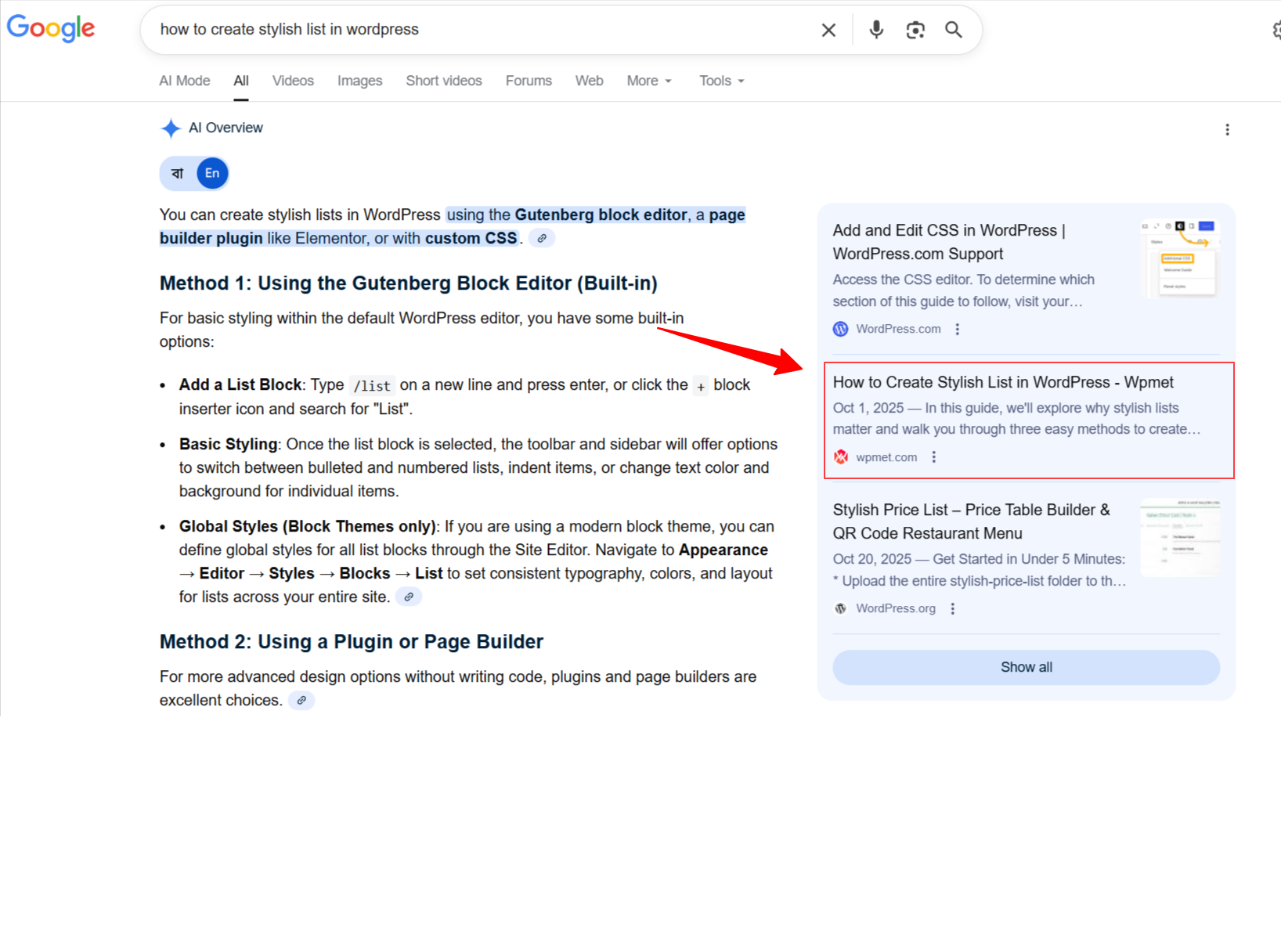
Whenever you’re going to search for something on Google, you’ll see the AI Overviews (formerly known as Search Generative Experience or SGE) at the very top of Google’s search results page (SERP).
The appearance of this AI Overview consists of:
- A Snapshot: A concise set of paragraphs that provides a straightforward answer to the query.
- Source Cards (Citations): On the right or at the bottom of the response, Google displays small source cards or “chips” that link to the websites used to generate the information. For publishers like Wpmet, these are crucial because they serve as the primary click-through path from an AI Overview.
- Expand AI Overview: Users can click “Show more” to reveal a deeper breakdown or a full, step-by-step guide.
- Follow-up: A dedicated “Ask a follow-up” button lets users continue the search in a conversational, chatbot format.
Google uses its Gemini models to generate AI Overviews by interpreting search intent, pulling information from top-ranking pages in real-time, combining insights from multiple sources into a clear, unified answer, and then citing the specific websites it used, typically those with strong authority and well-structured content. So, now you’ve some ideas on the Google AI Overview. Next, I will discuss why getting citations or mentions in this particular space is our top priority.
Why We Aim to Rank in Google’s AI Overview – and Why It Matters
Ranking in Google’s AI Overview matters because it places our content at the very top of the search results. As AI Overviews continue to push standard results further down the page, appearing in this section becomes crucial for maintaining visibility and staying competitive.
Previously, searchers relied on AI-generated summaries for some queries. But, over time, Google AI overview results are becoming more comprehensive and more satisfying against users’ queries. Meaning, more users are not scrolling down to the traditional organic listing.
Therefore, if your brand is not mentioned in the AI overview, your chances of getting clicks, traffic, and conversions decrease. On the other side, when your brand name is cited on the AI Overview can benefit your brand value and boost credibility among searchers.
And, many insights point out that links included in the AI summary section often attract curiosity-driven clicks when surfers search for more details.
Now, how has this Google SERP appearance shift impacted to Wpmet site?
First and foremost, we would like to thank our content marketing team, who are always passionate and dedicated to creating high-quality content. For years, we’ve been producing blogs, tutorials, guides, documentation, and a variety of other helpful content to help build better websites.
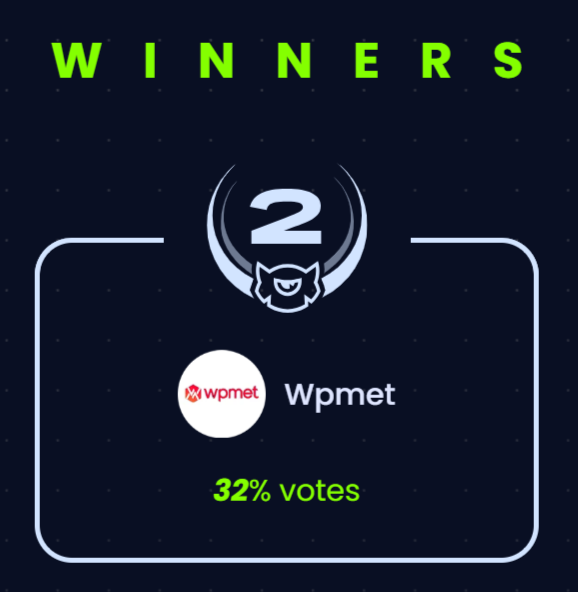
Not only our 3 million user base, but also other web designers & developers find our resources beneficial in their no-code website building journey. Recently, the Wpmet blog secured second place at the Monster Awards, earning over 30% of the total votes.
What we’ve found is that Wpmet has been mentioned in the Google AI Overview in response to many search queries. Then, to strengthen our chances, we remain focused on producing high-quality, relevant content and diversifying our overall marketing presence across platforms.
So far, we’ve seen little negative impact; instead, Google’s AI Overview has opened up new opportunities for our growth.
Let’s explore what approaches we’ve found effective to get featured in the Google AI Overview.
What Helps Wpmet to Feature in Google AI Overview: Essential Tips
Through our analysis of Wpmet’s performance, we identified that appearing in AI Overviews isn’t about “tricking” an algorithm; it’s about providing the best possible answer. Google’s Gemini models prioritize content that is authoritative, structured, and easy to digest.
Here are the core strategies that helped our content secure these premium placements:
Don’t Panic With Google AI Overview
Bringing AI to SERPs is a highly anticipated decision by Google. So, it wasn’t a surprise innovation at all. And, when they brought AI to SERP, our team took it as a great opportunity to reach searchers faster.
We were already confident in the quality of our content, which meant we knew we could handle any challenges that came our way. That confidence comes from the core principles we consistently follow to create content that’s genuinely helpful and reader-friendly.
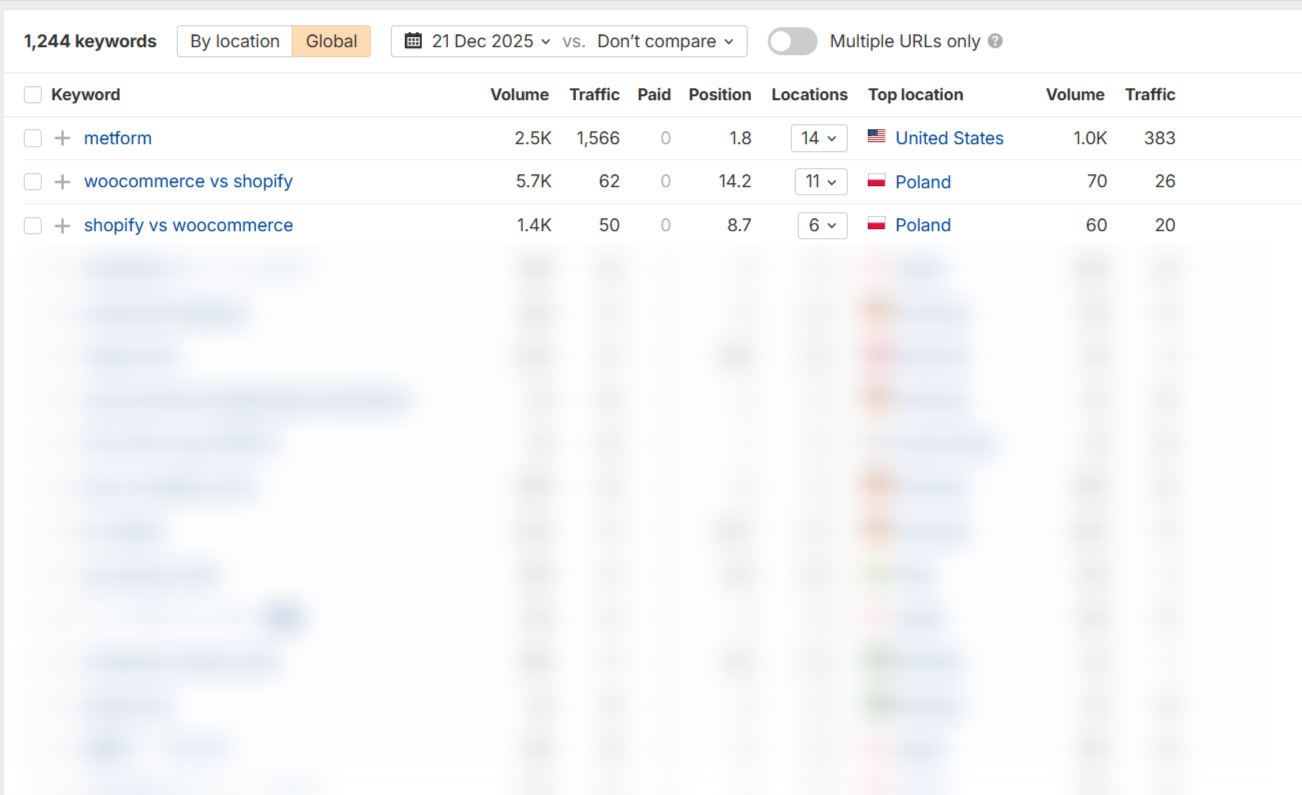
According to Ahrefs, 1244 keywords have been cited in the AI Overview till now.
And, we believe that these are pretty clear prerequisites for content publishing websites, regardless of whether you are targeting the AI overview space or not.
And, here they are:
- Design the content calendar around a core audience group, for Wpmet, this is mainly web designers and developers.
- Publish tutorial content using real products and practical, hands-on processes.
- Use authentic and relevant visuals, including screenshots, images, GIFs, and videos.
- Regularly update existing content and refresh media formats.
- Consistently cover trending topics, issues, campaigns, and most searched keywords.
- Focus on strong outlines and cover each topic in a comprehensive, in-depth manner.
- Sharing our content on different social platforms and groups.
To be honest, despite following the guidelines above, we have seen a slight decrease in visitor numbers. But we recovered quickly after implementing some quick steps. Up next, we’ll share those key steps.
Introducing Short Overview Section
Our first crucial step was introducing a “Short Overview” section in our blogs. We usually place it after the introduction, in a boxed style section. You can see one in this blog as well.
Generally, within this Short Overview, we answer the main topic query as Google AI Overview summarizes. We assumed that this addition would help AI-powered search engines to understand what we’ve covered in the entire blog. And then it becomes easy for SERP to decide whether it should recommend our blog in the AI Overview or not.
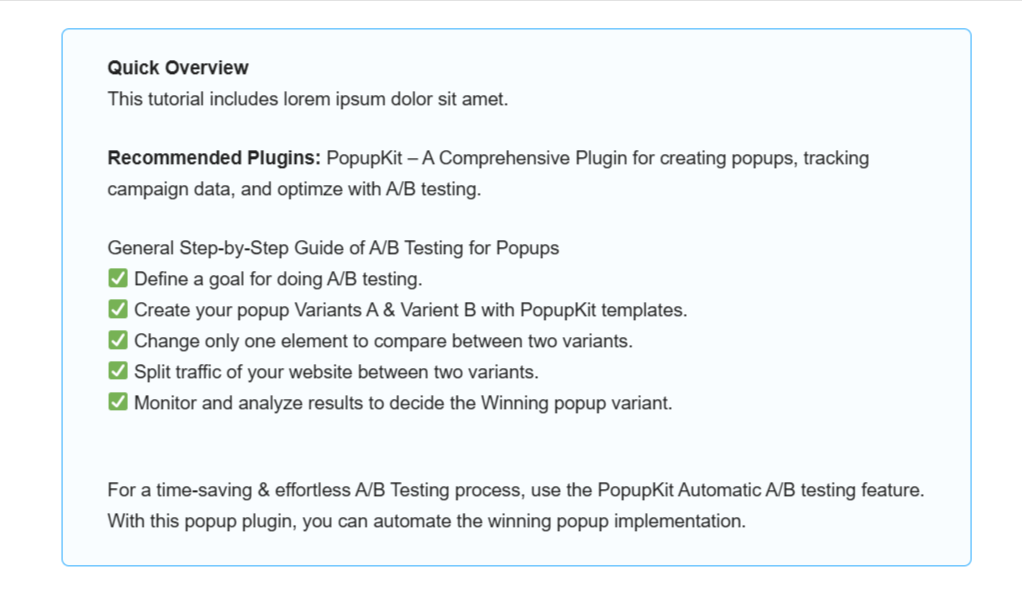
Keep in mind that this addition is not only to convince search engine algorithms but also to help our visitors get a quick snippet of the entire blog. Even though this is a common practice for blog writing, we are just tweaking a little to make it AI Overview-friendly.
Answer Complex Queries with Natural Language
We found that Google’s AI favors content that mirrors the conversational way users speak. Instead of writing stiff, keyword-heavy sentences, we optimized our posts to answer complex questions directly.
Our editorial policy also suggests maintaining a simple and clear voice in our writing. And, we focus on it more. Before making our content outlines, we think about the whole process from a real human perspective rather than the technical workflow.
Then, we try to cover the whole write-up in a conversational tone. And writing in clear, natural language allows AI systems to easily parse our explanations and synthesize them into accurate summaries for the user.
Cover Search Intent with High Quality Content
From our experience, we’ve figured out, surface-level content rarely earns visibility in AI Overviews. To stand out, we focused on fully satisfying search intent by going beyond the basics.
For example, instead of just writing on a broad topic like “How to create forms on websites,” we target more specific queries, for example:
- How to Create Product Online Order Forms in WordPress
- How To Create and Customize Food Order Forms in WordPress
- How to Add a Restaurant Reservation Form in WordPress
- How to Create a Loan Application Form in WordPress
This approach helps us create focused, clearer content that’s easier for both users and search engines to understand. Further, our tutorials and guides were expanded with clear, step-by-step instructions, real-world examples, and accurate, up-to-date data.
And, overall, we end up delivering a complete, “one-stop” resource that answers every key question around a topic. Therefore, we signal strong relevance and reliability, making our blog posts more likely to be recognized and cited as a primary source by AI.
Structure Our Content for Easy AI Parsing
Another thing, we realized early on that content must be easy to scan before it can be easy to summarize. If readers struggle to quickly grasp the key points, AI systems are likely to face the same issue. That’s why we intentionally structured every blog post with clarity and hierarchy in mind.
We relied heavily on logical H2 and H3 subheadings to break topics into meaningful sub-topics, making it clear what each part of the content is about. Long blocks of text were avoided in favor of short, focused paragraphs that deliver one idea at a time.
Image alt text also helps to show up in the AI Overview. Here’s an example, where our image appears in AI Overview:
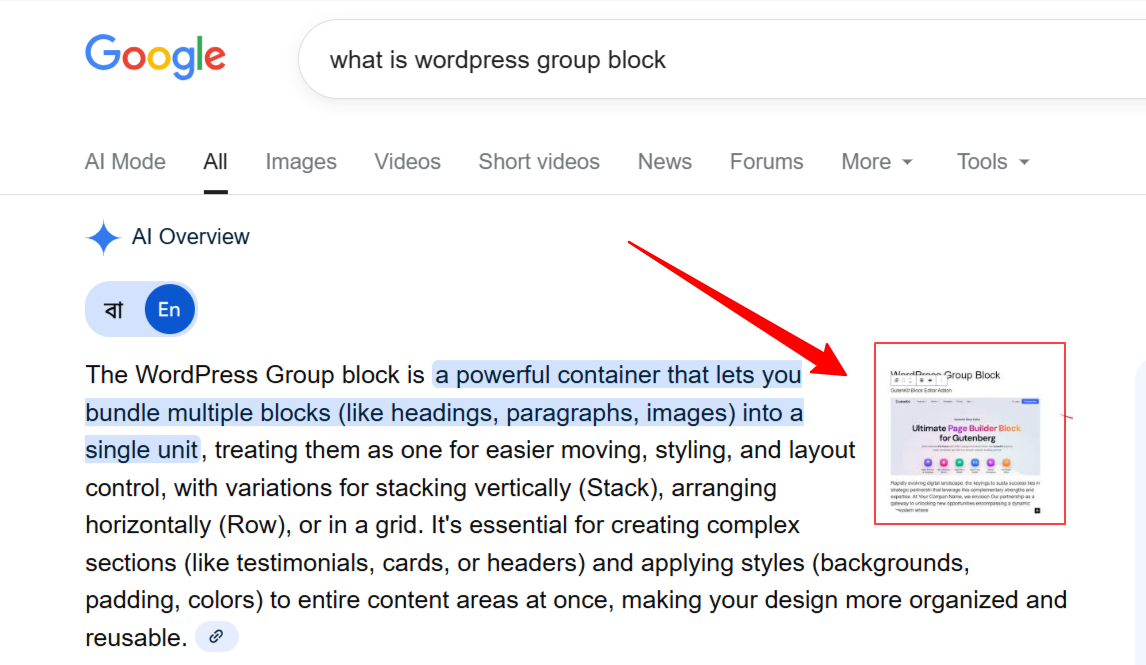
Most importantly, we made extensive use of bullet points, numbered steps, and tables to present information in a clean, digestible format. This structured approach acts like a roadmap for AI, helping it quickly identify and extract important elements such as feature comparisons, step-by-step guides, and key takeaways.
As a result, our content becomes easier for AI systems to parse, summarize, and surface in Google’s AI Overview, while also delivering a better reading experience for users.
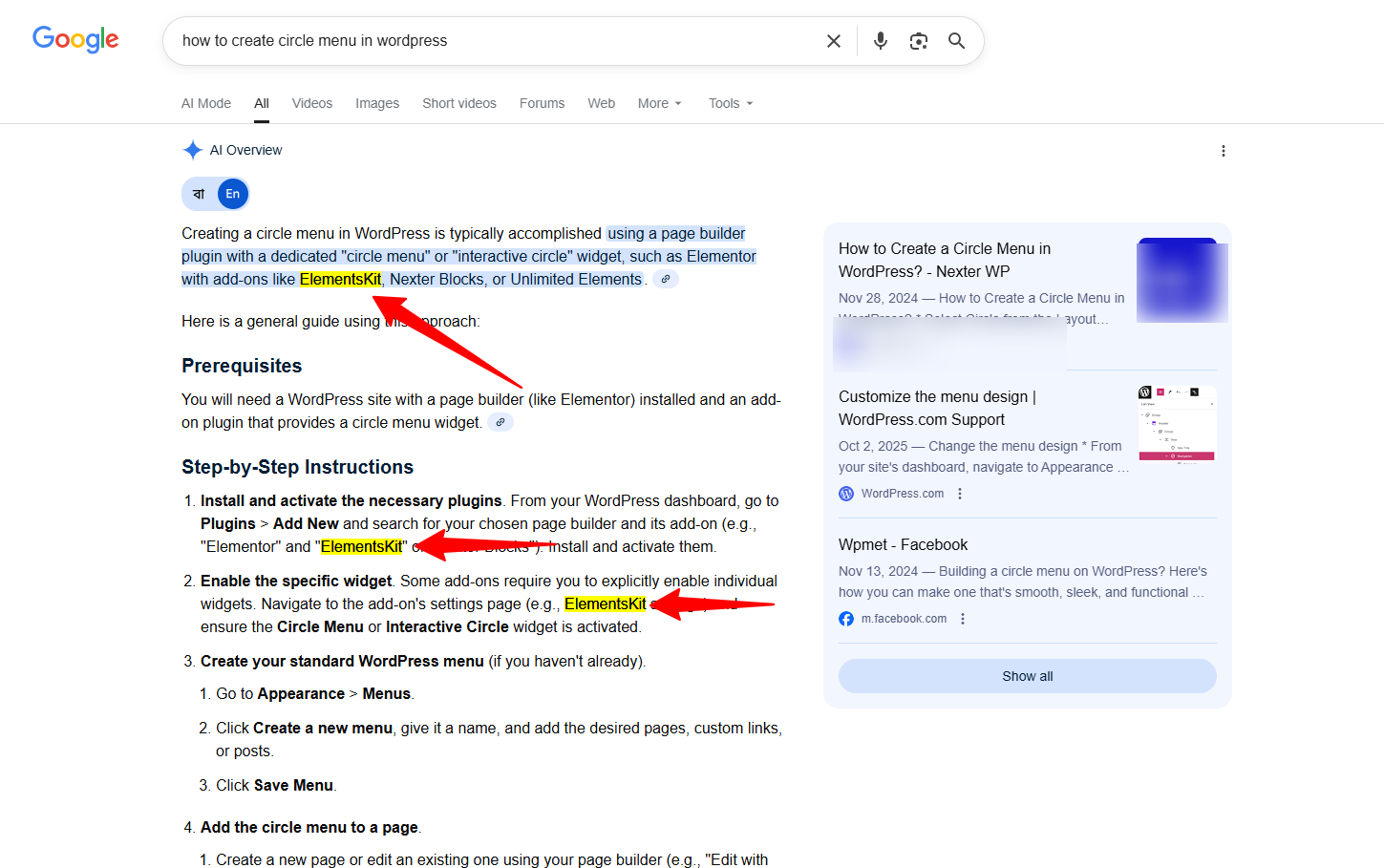
The above image shows how Wpmet’s blog’s step-by-step outline helps to feature our product in AI Overview. ElementsKit has been mentioned multiple times in the Google AI Overview’s step-by-step instructions.
Writing People-first Content, Not for Algorithm
Writing people-first content is nothing new for us. This is the approach from the very first day of publishing content on the Wpmet website. What we do here is:
Instead of forcing keywords into every paragraph, we always focused on clarity, readability, and usefulness. Each article is written with a clear goal: to solve a specific problem as efficiently and accurately as possible. We always give close attention to how readers think, what questions they ask, and where they might get stuck, then shape our content to guide them smoothly from start to finish.
Doing this, we are making our blogs easier to read and more engaging. And, prioritizing human understanding over algorithm tricks makes our content feel natural, informative, and genuinely helpful, exactly the type of content Google’s AI Overview is designed to recognize and feature.
So, you should shift your strategy from “writing for bots” to “writing for humans."
Covers More Long-Tail Keywords with Semantic Relevancy
To increase our visibility in Google’s AI Overview, we intentionally moved beyond short, generic keywords and focused on long-tail, informational queries that reflect how users actually search. Instead of targeting broad terms, we created content around intent-driven searches
For example, earlier we might have published a blog on a broad topic like “How to add particle effects to websites.” Now, we take a more targeted approach by focusing on specific, long-tail keywords. We start by identifying a particular CMS user and then narrow it further by considering which page builder or tool the reader is likely using.
This thought process ended up with a topic like “How to Add Particle Effects to Your Gutenberg Website.” In this way, your queries may have lower search volume, but they carry much clearer intent and higher relevance.
Alongside long-tail keywords, we paid close attention to semantic relevancy. That meant naturally incorporating related terms, variations, and contextual phrases throughout the content – but no keyword stuffing. We also addressed common follow-up questions within the same article, ensuring the topic was covered from multiple angles rather than in isolation.
This approach helped AI systems better understand the full context and depth of our content. By clearly connecting related ideas and answering conversational queries in one place, our articles became relevant to a broader range of searches. As a result, Google’s AI could confidently surface our content as a reliable source for nuanced, intent-driven questions in its AI Overview.
Regularly Update and Refresh Outdated Content
Content freshness plays a critical role in building trust and credibility, especially for niches like WordPress that evolve rapidly. We recognized that even well-written articles can lose relevance over time if they aren’t maintained. That’s why we made content auditing a regular part of our workflow instead of a one-time task.
We routinely review older blog posts to identify outdated information, broken steps, or features that have changed. These articles are then refreshed with the latest WordPress updates, new plugin functionalities, current best practices, and up-to-date screenshots or visuals. In many cases, we also expand sections to address new use cases or recently emerging questions from users.
This consistent updating process sends a strong signal to Google that our content is accurate, current, and reliable. For AI systems that prioritize trustworthy sources, freshness becomes a key deciding factor. As a result, regularly refreshed content stands a much higher chance of being selected and surfaced in Google’s AI Overview as a dependable snapshot of the topic.
Add Relevant Schema Markup for Better Understanding
To help both search engines and AI systems fully grasp the context of our content, we implemented relevant schema markup (structured data) across our site. Schema markup essentially “etichette” different types of content, telling search engines exactly what each page is about—whether it’s a HowTo guide, an FAQ, a Product page, or another type of content.
By adding this structured data, we remove ambiguity and make it easier for Google’s algorithms and AI to accurately parse, understand, and categorize our content. This not only improves indexing but also makes our pages eligible for rich results, such as featured snippets, knowledge panels, or AI-generated overviews.
Moreover, schema markup helps AI identify key elements like step-by-step instructions, lists, or product details without having to infer them from the text alone. This increases the likelihood that our content will be cited correctly, displayed prominently in AI-driven summaries, and recognized as a reliable, authoritative source. Over time, this structured approach has become a fundamental part of ensuring that our content is both discoverable and AI-friendly.
Establish Your Site as a Trusted Authority
Authority takes time, but it’s essential for appearing in Google’s AI Overview. AI and Google prioritize content from trusted, expert sources. We consistently published in-depth WordPress and Elementor tutorials, covering both basics and advanced topics, while creating interconnected articles to build topical depth.
Earning high-quality backlinks further reinforced our credibility, signaling that our content is authoritative. As our site’s E-E-A-T (Experience, Expertise, Authoritativeness, Trustworthiness) grew, so did our visibility in AI-driven summaries, showing that consistent, high-quality content is key to being recognized as a reliable source.
Keep Winning at Traditional SERP Rankings
Getting AI Overview citations is now becoming an important factor. But that doesn’t mean the importance of ranking in the traditional listicle ranking of SERP is being compromised. Our editorial team’s study has shown that ranking in the top 1-4 positions on standard search results was much more likely to be featured by the AI. Therefore, traditional SEO best practices remain the foundation of our AI visibility strategy.
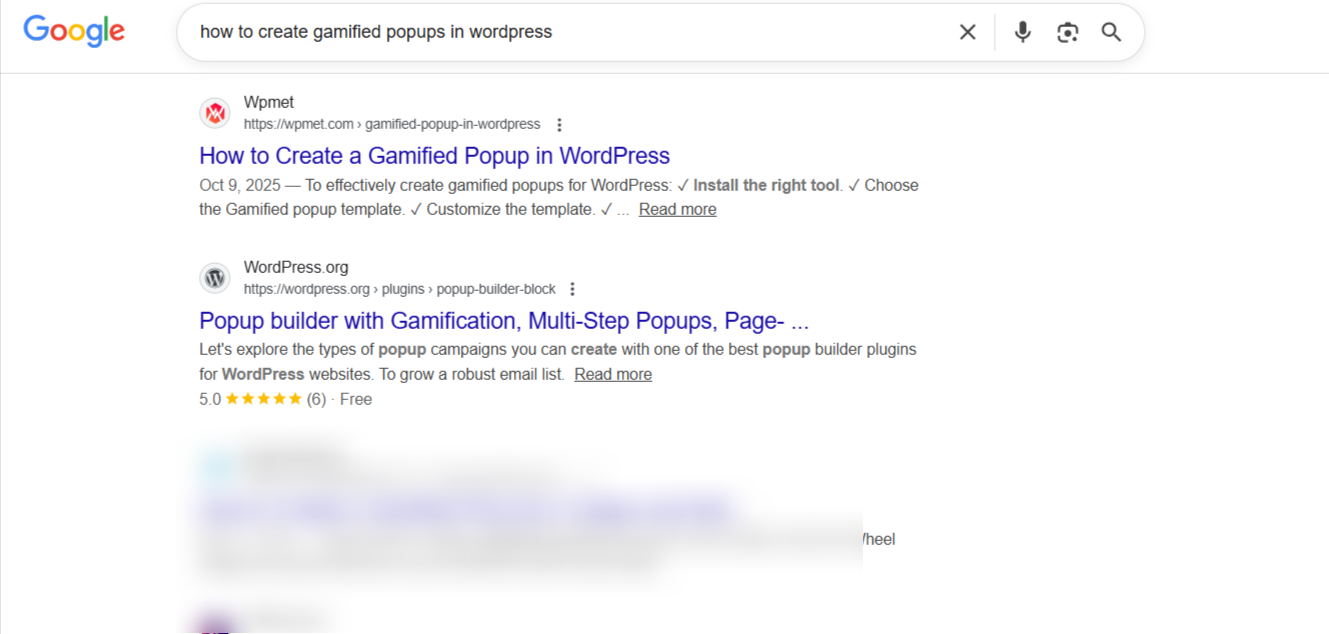
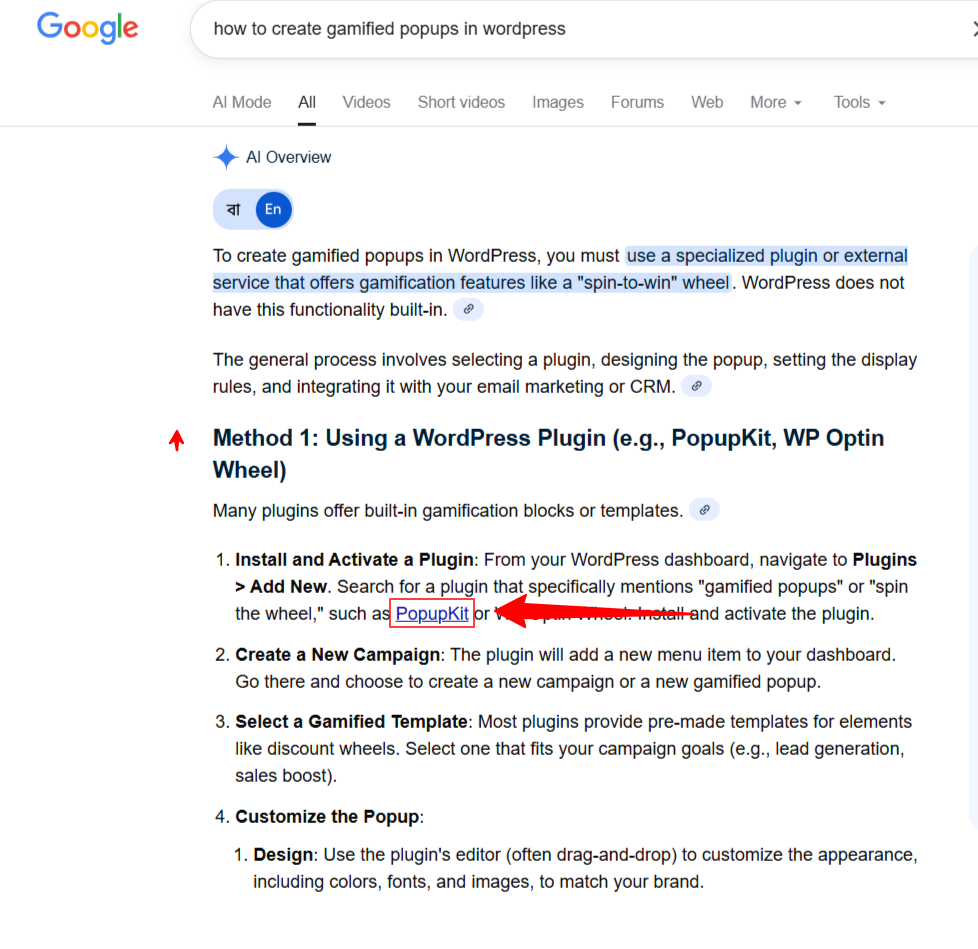
Here’s a real example, for the keyword, “How to create gamified popups in WordPress” Wpmet’s blog ranked first. Therefore, our product PopupKit gets mentioned in the AI Overview.
Best SEO Practices for Highlighting in Google AI Overview?
Now, you know what helps Wpmet to frequently get citations in Google AI overview. We’ve shown our ways with examples. To increase the likelihood of appearing in Google AI Overview, we’ve also noted some best SEO practices:
- Prioritize Crawlability
Ensure your site is easy for search engines to crawl and index by maintaining a clean site structure, fast-loading pages, and proper internal linking. If Google can’t access your content efficiently, it can’t surface it in AI Overviews.
- Monitor Overall Visibility Shifts
Track changes in impressions, clicks, and rankings as AI Overviews roll out. Understanding visibility trends helps you identify whether AI results are affecting your traffic positively or negatively.
- Track Your AI Overview Rankings
Regularly check which keywords trigger AI Overviews and whether your content is being cited. This insight helps refine content strategies that improve inclusion and visibility.
- Follow E-E-A-T principles
Demonstrate experience, expertise, authoritativeness, and trustworthiness through accurate content, clear authorship, and credible sources. AI systems favor content that shows strong reliability signals.
- First Hand Experience
Content based on real use, testing, or practical experience adds depth and authenticity. This makes your content more valuable and more likely to be referenced in AI summaries.
- Earn High-Quality Backlinks
Backlinks from authoritative and relevant websites strengthen your site’s credibility. Strong link signals increase the likelihood of your content being selected as a reliable source.
- Get Mentioned (Even Without Links)
Brand mentions across the web help build topical authority and trust. Even unlinked citations can reinforce relevance signals that support AI Overview inclusion.
Upcoming Plans for Wpmet!
Till now, we’ve never followed any shortcuts to achieve the Google AI overview citation. We will continue to focus on what already works. Clear, people-first content, strong structure, real expertise, and consistent optimization all play a key role in helping AI understand and trust your site.
Apart from that, the long-term impact of AI Overviews is still evolving; one thing is clear: websites that prioritize quality, relevance, and authority are best positioned to benefit. So, keep your eye on Wpmet.com/blog or subscribe to our email, and we’ll give you an update if we find anything proven for getting featured on AI Overview.


Lascia un commento